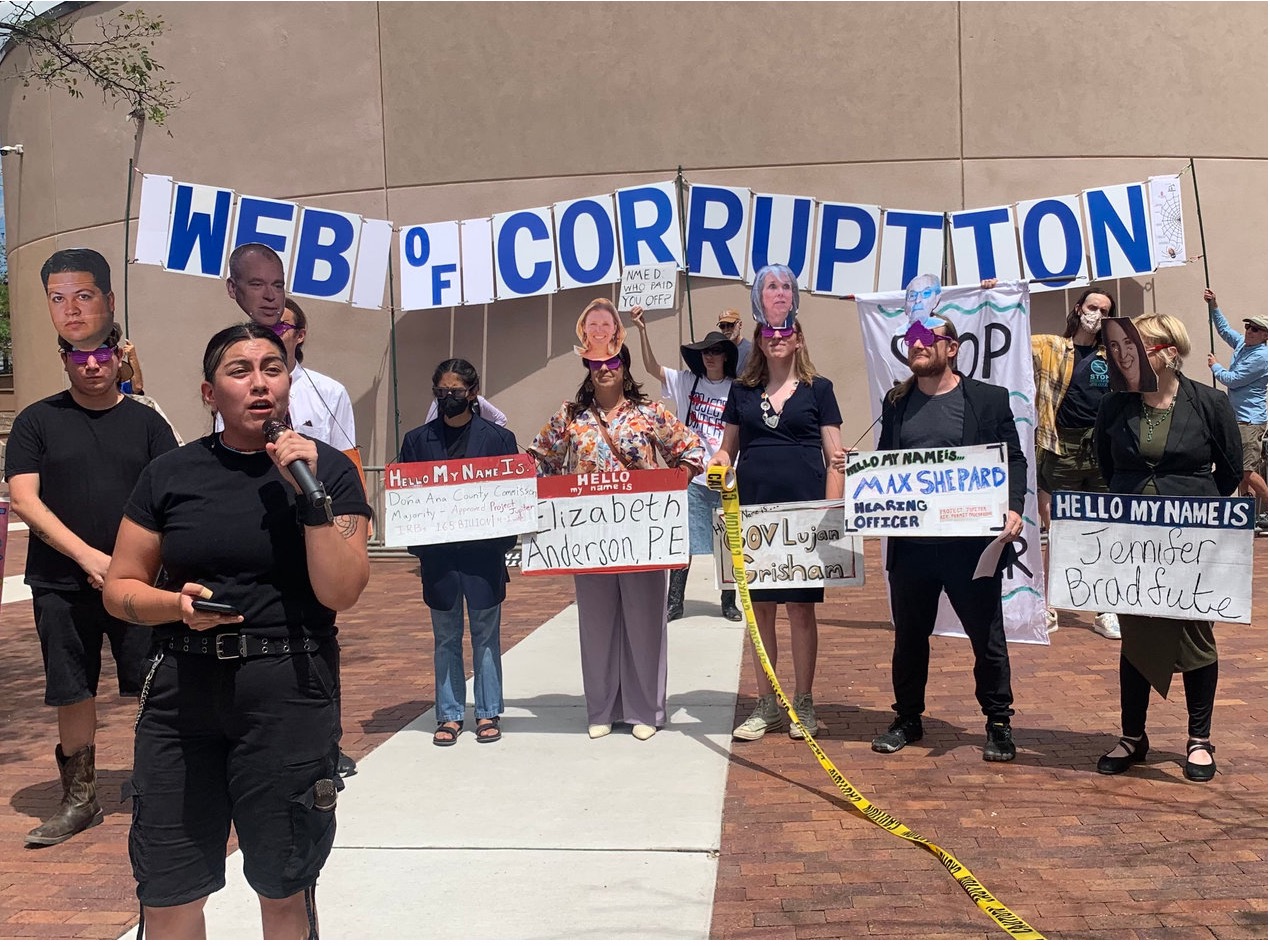
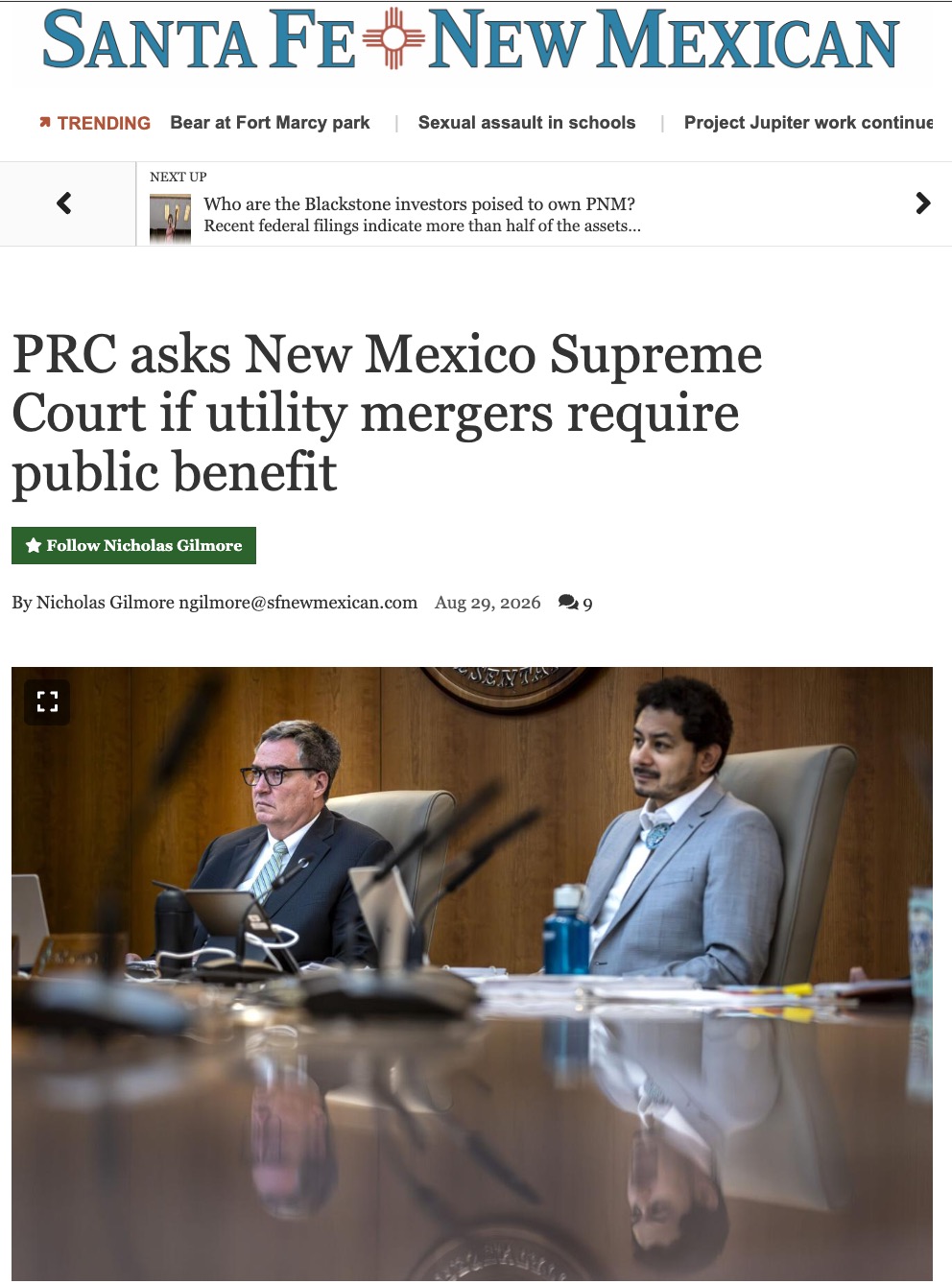
 You may recall that New Energy Economy appealed the PRC's July decision to approved the Bernhard Capital Partners purchase of NM Gas Company to the NM Supreme Court. On August 18th the PRC filed an extraordinary motion in that case, asking the New Mexico Supreme Court to issue an advisory opinion clarifying the legal framework governing acquisitions of utilities, or in the alternative, to expedite their decision on our BCP appeal because of the pending Blackstone case.
The motion from the PRC poses an absurd question. They write "Before determining whether a proposed acquisition satisfies the applicable legal standard, the Commission must know what that standard is." That's quite an admission! New Energy Economy's response on Friday last week argues that the PRC should have been clear about the legal standard before it decided the BCP case. That is the basic job of a regulator. The question in this case is not what the law is. The question is whether the Commission followed the law when it approved this takeover. For nearly three decades the PRC has evaluated utility acquisitions under a public-interest framework that examines whether customers receive affirmative benefits and whether those benefits outweigh the transaction’s risks. The Commission’s established Six-Factor Analysis examines customer benefits, preservation of Commission jurisdiction, service quality, improper subsidization of non-utility activities, the qualifications and financial health of the proposed new owner, and protections against harm to customers. Now, after approving the acquisition of NM Gas Company, the Commission has asked the Supreme Court for “more certainty and clarity” about the legal framework governing utility acquisitions. Commissioners Patrick O’Connell and Greg Nibert articulated a dramatically different standard when they voted to approve the BCP acquisition, with Chairman O’Connell stating during the July 30th meeting that “the merger standard is continuation of service.” The law governing mergers was there before the hearing. Thirty years of precedent was there before the hearing. The parties spent more than a year presenting testimony and evidence under that established standard. The PRC cannot change the rules after the game is over and then ask the Supreme Court to retroactively bless what it did. We also argued that continuation of service is not a meaningful standard. The PRC is New Mexico’s constitutionally created utility regulator for a reason. Its job is to regulate, not rubber-stamp. Careful verification of the qualifications and financial health of a new owner, determining whether customers actually receive benefits, examining the risks of the transaction and ensuring that the benefits outweigh those risks are not optional extras. That is the regulator’s job. Replacing that inquiry with ‘continuation of service’ turns regulatory oversight into abdication. As one reader in the New Mexican commented "If the public benefit is not part of the equation, exactly what is the purpose of regulation." Yesterday we filed our Statement of Issues in the BCP appeal case at the NM Supreme Court. |